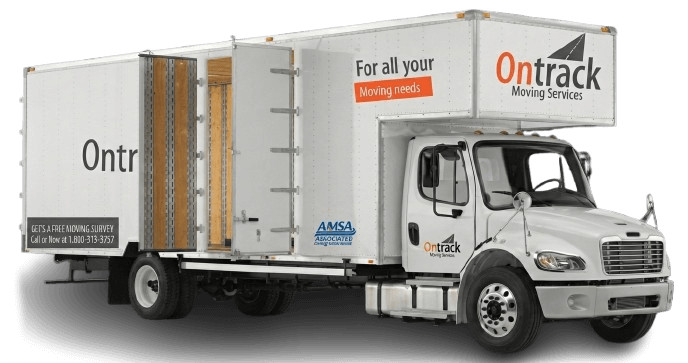

Piano Moving Specialists
Precision Piano Moving.
Because 12,000 Parts Don't
Like Being Jolted.
Specialized technical handling for Steinway, Bosendorfer, and Yamaha. From Victorian walkups in Pacific Heights to Paradise Valley estates. We use the right boards, the right straps, and the right science. A piano is not a heavy box. It is a calibrated instrument with a cast iron plate under 20 tons of string tension, a crowned soundboard that flexes with humidity, and a lacquer finish that records every scratch permanently.
Moving + Storage under one roof, one company, one point of contact Plus complimentary moving blankets, wardrobe boxes, and floor protection with every move.
Piano Moving: Quick Facts
- Piano Types: Uprights, spinets, baby grands, parlor grands, concert grands
- service areas: San Francisco Bay Area (40+ cities) and Phoenix Metro (15+ cities)
- Equipment: Piano boards, heavy-duty straps, padded covers, piano dollies
- Crew Size: Typically 3 to 4 for grands, and 2 to 4 for uprights. Final crew size depends on piano weight, stairways, and access conditions for proper crew safety.
- Credentials: USDOT #2551548 | CA License CAL-T190721 | A+ BBB
- Storage: Climate-controlled in Peoria AZ, secure and monitored in Hayward CA
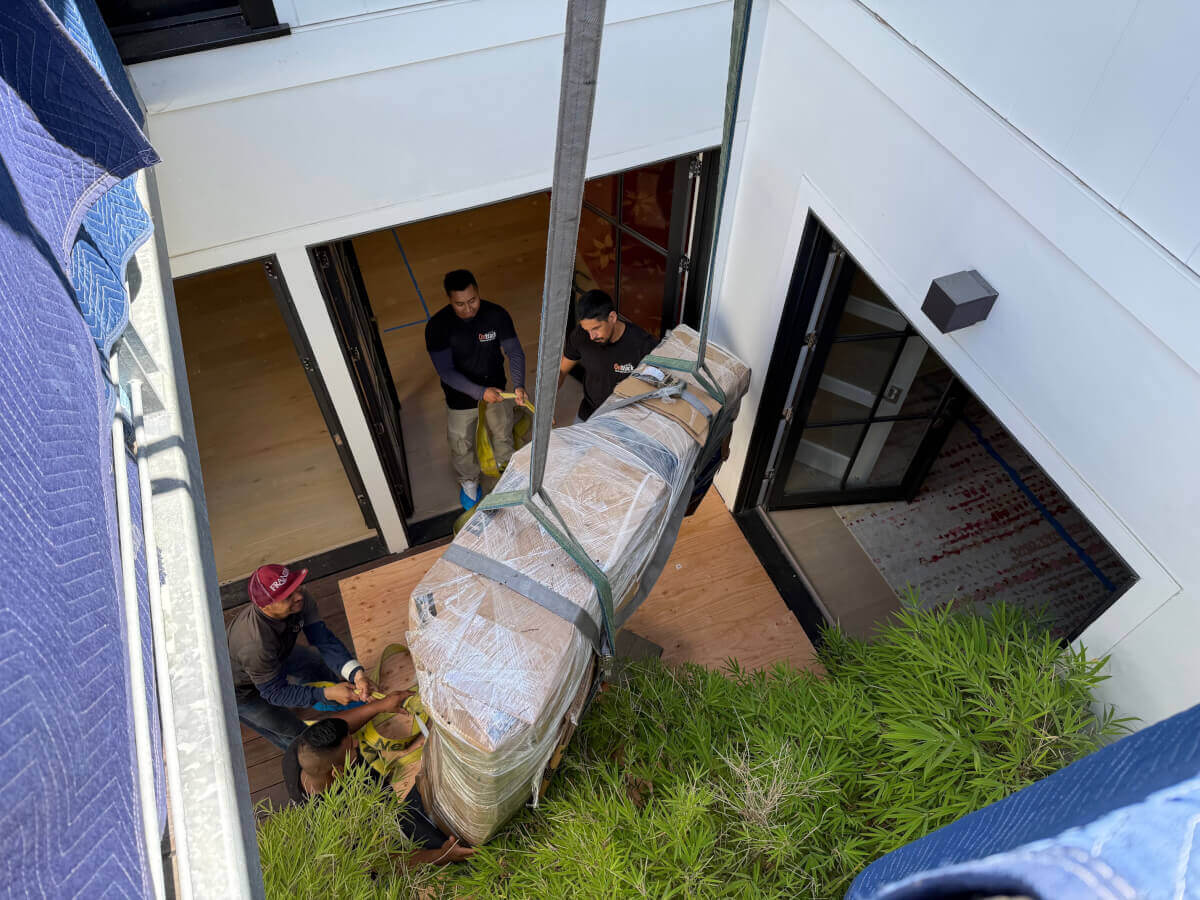
Standard movers vs. piano handlers
It's Not Just Heavy. It's Calibrated.
A standard mover sees a heavy object and wraps it in blankets. A piano handler sees a cast iron plate under 20 tons of string tension, a crowned soundboard that can crack if the humidity shifts too fast, and 230 steel strings pulling against a pin block that has to hold every string at pitch under that load. The difference between these two perspectives can be the difference between a routine move and a five-figure repair bill.
The "Grand" Protocol: Lyre Removal and Skid Board
We do not just "disassemble" a grand piano. We expertly remove the lyre-pedal assembly and each leg, marking bolt positions. We use a padded Skid Board (Piano Board) to transport the body on its side, which keeps lateral stress off the cast iron plate. "Dropping a leg" is the specific coordinated move where our crew transitions a grand piano onto the board in a single controlled motion. It takes three people, precise timing, and 15 years of practice.
The "Upright" Rule: We Do Not Roll Pianos on Their Casters
Those small brass wheels on the bottom of your upright are not transport casters. They are made for repositioning the piano within a room, not for moving it across a house. Rolling an upright on its own casters across hardwood or Spanish tile permanently scores the floor and stresses the piano's internal bracing. We use 4-wheel rubber-tired dollies that distribute weight evenly and are chosen to avoid scuffing your floors.
High-End High-Rise Clearance
High-End towers in SoMa, Rincon Hill, and Downtown Phoenix typically require a Certificate of Insurance before they open the freight elevator, and each building sets its own requirements, so confirm yours with your building manager. We carry a $10M Combined Protection Tower for the building and premises, and we issue COIs promptly on request to your building manager. Your instrument is covered separately by basic $0.60/lb cargo liability per article, and additional valuation protection is available for purchase.
Piano types
Piano Sizes and Configurations We Handle
Upright Pianos
300-650 lbs
Spinets (36 to 40 inches tall), consoles (40 to 44 inches), studio uprights (45 to 48 inches), and full professional uprights (48 to 52 inches). Moved upright on a piano dolly, wrapped in padded covers, and secured with locking straps. The most common piano move.
Baby Grands
500-650 lbs
4 to 5 feet in length and roughly 40 inches tall with the lid closed. Legs and pedal lyre removed, placed on a piano board on its side, wrapped and strapped. We mark each leg for proper reassembly.
Parlor Grands
600-800 lbs
5.5 to 6.5 feet in length. Same disassembly process as baby grands but may require additional crew members and wider pathway clearance. Often found in music rooms and studios.
Concert Grands
800-1,200 lbs
7 to 10 feet of precision engineering. Steinway, Bosendorfer, Fazioli. These moves require our most experienced crews, custom crating options, and coordination with a licensed crane or rigging contractor by separate written agreement when standard access is not possible.
Digital Pianos
25-200 lbs
Electric pianos, keyboards with stands, and digital consoles. While lighter, these still require proper padding and care to pad electronic components and finishes.
Antique Pianos
Weight varies | Custom assessment
Square grands, Victorian uprights, and player pianos require extra care for aged wood, ivory keys, and fragile mechanisms. We assess each antique individually.
Professional equipment
The Right Tools for the Job
Piano Board
Heavy-duty wooden skid that supports the piano on its side during transport. Padded surface reduces contact with the finish during transport.
Heavy-Duty Straps
Ratcheting straps with locking buckles rated for 1,000+ pounds. Secures the piano to the board and inside the truck.
Padded Covers
Thick quilted covers designed for piano finishes. Protects lacquer, polyester, and hand-rubbed finishes from scratches.
Piano Dolly
Four-wheel rubber-tired dolly designed for piano weight distribution. Protects floors and allows precise maneuvering.
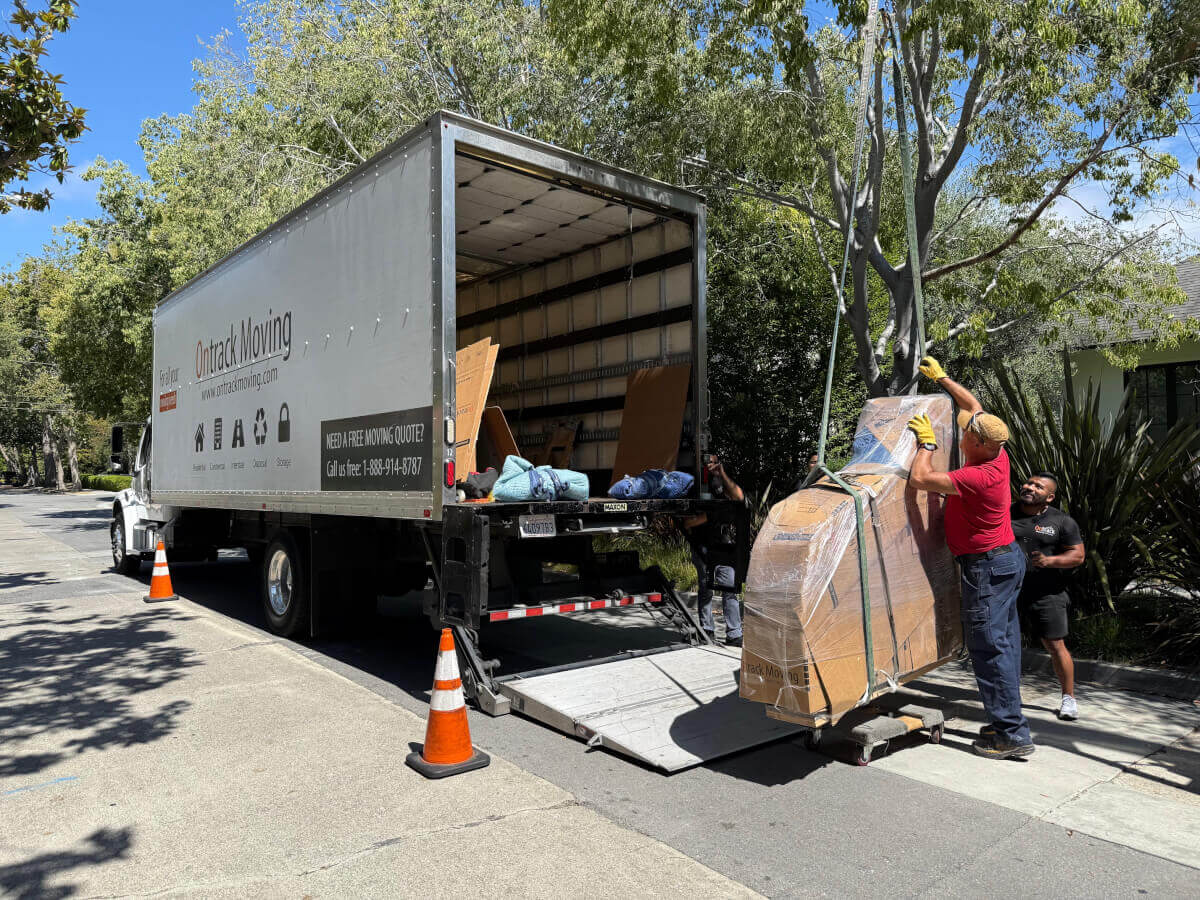
Our own trucks. Our own crews.
Branded Trucks. Liftgate Loading. Safety Cones.
Pianos move on Ontrack trucks equipped with hydraulic liftgates, using liftgate loading rather than a hand-carry wherever the site allows. No borrowed vans. The piano is wrapped, strapped to the board, and loaded level onto the truck bed. Safety cones mark the work zone. Our name is on the truck because we are the ones doing the work.
Asset-based carrier. USDOT #2551548.
The expertise gap
Ontrack Piano Handlers vs. Standard Movers
A piano is not a refrigerator. The crew that moves it should understand string tension, soundboard crowns, and cast iron plate stress. Most do not.
| Factor | Ontrack Piano Handlers | Standard Movers |
|---|---|---|
| Grand Piano Handling | Padded Skid Board and lyre-pedal removal. Controlled "leg drop" transition by a 3-person trained crew. Cast iron plate kept off lateral stress by the board. | Improvising with furniture blankets. Attempting to roll the piano on its own legs. No skid board. |
| Floor Protection | 4-wheel rubber-tired dollies (floor-friendly). We do not roll pianos on the decorative casters. Weight is distributed evenly across rubber wheels designed for hardwood and tile. | Rolling on the piano's own brass casters. Permanent scoring on hardwood, Spanish tile, and marble floors. |
| Climate Strategy | Vapor barriers. Acclimation Protocol for the Bay Area to Phoenix corridor (60% humidity → 15%). Climate-controlled storage in Peoria, secure monitored storage in Hayward. | No climate protection. Soundboard cracking risk, tuning pin loosening, and finish damage from uncontrolled temperature swings. |
| Building Access | $10M building liability COI issued promptly on request. Instrument coverage is separate: basic $0.60/lb cargo liability per article. Pre-coordination with building managers at SoMa high-rises, Rincon Hill towers, and Paradise Valley HOAs. | Insufficient insurance. Move delayed or denied by building management. COI scramble on move day. |
| Instrument Knowledge | Crews understand string tension, soundboard crown, harp alignment, and pin block integrity. 15 years of piano-specific handling. | Treats the piano as a "heavy box." No understanding of internal mechanics. Improvised strapping that stresses the cabinet. |
Ontrack Moving® is a licensed carrier (USDOT #2551548) with dedicated piano crews serving the Bay Area and Phoenix. Your instrument is transported on Ontrack Moving® equipment by Ontrack Moving® crews.
How it works
Our Piano Moving Process
Assessment
Tell us your piano type, current location, and destination. We confirm doorway widths, stairs, and any access challenges at both locations.
Preparation
On moving day, we lock the keyboard lid, wrap the cabinet in padded covers, and for grands, carefully remove and wrap legs and lyre.
Transport
Piano is secured to the board, loaded onto the truck with a ramp, and strapped in place. We drive carefully, avoiding sudden stops.
Placement
At your new location, we reassemble grand piano legs, place the piano in its designated spot, and recommend waiting 2-4 weeks before tuning.
The Bay Area to Phoenix corridor
Managing Soundboard Risk on the Desert Corridor
A piano is a living piece of wood. The spruce soundboard expands and contracts with moisture. In San Francisco, your piano has been living in roughly 60% relative humidity. Load it on a truck and drive it to Phoenix, and within 12 hours it arrives in 15% humidity. That kind of moisture loss makes the soundboard shrink, the crown flatten, and the tuning pins loosen in their holes. The wood does not "adjust." It cracks.
This is why we developed our Acclimation Protocol for the CA-AZ corridor. We wrap the piano in vapor barriers before transport to slow the rate of moisture exchange. Our transport plan is built to limit the instrument's exposure to the extreme thermal swing between the coast and the desert floor. At the destination, we recommend a 2-4 week acclimation period before tuning.
Why the CA → AZ Route Is Dangerous for Pianos
Humidity Drop: 60% → 15%
Spruce soundboard shrinks. Crown flattens. Glue joints separate. The harp (cast iron plate) does not shrink, so the wood pulls away from the frame.
Temperature Swing: 65°F → 115°F
Lacquer finishes soften and bubble. Tuning pins expand in the block. String tension changes by several pounds per string across 230 strings.
Our Acclimation Protocol
Vapor barriers slow moisture exchange. Climate-controlled storage available in Peoria for gradual acclimation. Hayward offers secure, monitored storage with naturally moderate Bay Area temperatures.
Interstate authority: USDOT #2551548 | MC #889001
Piano moving challenges
Obstacles We Handle Every Day
Stair Moves
Ground floor to ground floor is standard. When stairs are involved, we assess each situation individually based on stairway width, turns, and complexity. We may decline moves where conditions create excessive risk.
Tight Doorways
Standard doors are 32 inches and baby grands are around 58 inches wide, but on the skid board the piano travels on its side, so the case depth is what has to clear the opening. We measure in advance, remove doors from hinges when needed, and angle the piano precisely to clear openings.
Humidity and Temperature Shock
Moving from 60% humidity in the Bay Area to 15% in Phoenix can crack a soundboard in days. We use vapor barriers, climate-aware transport, and our Acclimation Protocol. For local moves, we minimize outdoor exposure and schedule around extreme weather.
High-End High-Rise Access
Towers in SoMa, Rincon Hill, and Downtown Phoenix typically require a Certificate of Insurance before the freight elevator opens, and each building sets its own requirements. We carry $10M Combined Protection Tower for the building and premises, and we issue COIs promptly on request to your building manager. Your instrument is covered separately by basic $0.60/lb cargo liability per article, and additional valuation protection is available for purchase. We coordinate loading dock reservations and move windows.
Storage Needs
Moving but your new home is not ready? Our Peoria warehouse offers climate-controlled storage for pianos, and our Hayward warehouse provides secure, monitored storage with mild coastal temperatures.

Highly recommend this team
Mauricio and José were incredible! They got here on time and were VERY professional. What I thought was going to take 4 hours they did in 1 hour and even helped me with small things like putting clothes away. I would highly recommend these 2 any day and if I have any more moving I will be specifically asking for them.
Verified on Google
Best piano moving experience so far
I was so impressed with the level of professionalism your movers had. They were quick but careful and showed me every step of the process from start to finish. They also took time to educate me on storage techniques and advised me on how long to wait before tuning. I have had the piano moved five times and this was definitely the best experience so far.
Verified on Google
On time and efficient
Alejandro and Mauricio very good work. On time and move was efficient ! Appreciate their work !
Verified on Google
Service areas
Piano Moving in Two Markets
San Francisco Bay Area
Piano moving throughout the Bay Area from our Hayward headquarters. Victorian walkups, hillside homes, downtown high-rises.
Specialty moving
Related Specialty Services
White Glove Moving
Specialized handling for fine art, antiques, and high-value items. The same care we give pianos, applied to your entire household.
Learn MorePiano Storage
Climate-controlled in Peoria AZ. Secure, monitored in Hayward CA with naturally moderate coastal temperatures.
Learn MorePacking Services
Professional packing for the rest of your home. Let us handle everything while your piano gets the special attention it deserves.
Learn MoreCommon questions
Piano Moving FAQs
Piano moving costs vary based on the type of piano, distance, access conditions (stairs, narrow doorways, long carries), and crew size required. Factors like stairwell turns, elevator availability, and parking distance all affect the final cost. Every piano move is different, so we provide free custom quotes based on your specific piano, current location, and destination. Final charges will be based on actual labor time, materials used, access conditions, scope changes, waiting time, and any additional services requested or required to complete the move. Contact us with your details for an accurate estimate. For an example of a staircase piano carry, see our white-glove household move case study, where an upright piano was carried from the ground floor up to a second floor on a staircase planned and padded in advance.
Yes. Pianos should be tuned 2-4 weeks after a move to allow the instrument to acclimate to its new environment. Changes in temperature and humidity affect string tension and soundboard response. Tuning immediately after a move is not recommended because the piano is still adjusting. We can recommend trusted piano tuners in the Bay Area and Phoenix who work with our clients regularly.
We use specialized piano moving equipment including piano boards (heavy-duty wooden skids), heavy-duty ratcheting straps with locking buckles, piano dollies with rubber wheels that protect floors, thick padded covers designed for piano finishes, and ramps for truck loading. Grand pianos are carefully disassembled (legs and pedal lyre removed) and transported on their side secured to the piano board. Each leg is marked for proper reassembly.
Our standard is ground-floor-to-ground-floor piano moving. For stairs, we evaluate each situation on a case-by-case basis, assessing stairway width, turns, landing areas, and overall complexity. Due to the risk of crew injury and potential property damage with pianos weighing 300 to 1,200 pounds on stairs, we may decline moves where conditions create unacceptable risk. Contact us with photos or details of your access for an honest assessment.
Pianos are wrapped in thick quilted covers made for piano finishes, including lacquer, polyester, and hand-rubbed wood. Keys are locked or covered with padding to limit movement. Grand pianos have their legs and pedal lyre carefully removed and wrapped separately. We use corner protectors on exposed edges and secure the piano with heavy-duty straps inside the truck to limit shifting in transit.
Yes. Our Peoria, Arizona warehouse is climate-controlled, ideal for piano preservation in the desert where temperatures can exceed 115 degrees F. Our Hayward, California warehouse is secure and monitored, benefiting from naturally moderate Bay Area coastal temperatures. Temperature swings and dry air can crack soundboards, damage finishes, and affect tuning stability. Pianos are stored upright where the instrument allows, and kept away from exterior walls. Short-term and long-term storage options are available at both locations.
Every move includes basic cargo liability at $0.60 per pound per article. Federal law requires movers to present two levels of liability, and $0.60/lb is the level that applies when the shipper waives full value in writing. On a piano, $0.60/lb is far below replacement cost, so additional valuation protection is strongly recommended and we go over the options before your piano move.