Residential Case Study

Case Study: A White-Glove Pack-and-Move for a Large Home in Hillsborough

A high-end Peninsula household packed in one day and moved the next, with floor and stair protection at both ends, soft-crated furniture, artwork in picture boxes, and an upright piano carried up to a second floor. Here is how it was run.

By Pablo Giordano, Owner, Ontrack Moving®  •  June 2026  •  9 min read

Residential Case Study

Pack One Day, Move the Next, Handle Everything Carefully

A family was moving into a large home in Hillsborough, one of the most established addresses on the San Francisco Peninsula, and the brief was simple to say and hard to do: handle the house carefully. This is an anonymized account of how Ontrack Moving ran a high-end household move as a two-day pack-and-move, with fine furniture, framed artwork, and an upright piano that had to go up to a second floor.

In short: this was a white-glove residential move where the care mattered more than the speed. A full crew packed the home room by room on the first day, then a larger crew with two trucks moved it the next. Hardwood floors were protected with runners, stairs and door frames were padded, delicate furniture was soft-crated and wrapped, and artwork went into glassine and picture boxes. The upright piano was carried from the ground floor at the origin up to a second floor at the new home, with the staircase planned and padded before the lift.

That is the difference between a careful household move and a fast one. For moves like this, see our white-glove moving and full-service packing teams.

TL;DR (30-Second Summary)

  • The job: a high-end household move into a large home in Hillsborough, on the San Francisco Peninsula.
  • Two days, two jobs: a full crew packed the home the first day; a larger crew with two trucks loaded, moved, and unloaded the next.
  • Floors and stairs first: protective runners over the hardwood, padded door frames and stair edges, laid down before anything was carried.
  • Fine furniture and artwork: delicate pieces soft-crated and padded; framed art and mirrors in glassine and picture boxes.
  • The piano: an upright piano carried from the ground floor at the origin up to a second floor at the destination, with the staircase planned and padded in advance.
  • Coverage: $10,000,000 building and property liability, plus standard $0.60 per pound per article cargo liability under federal FMCSA rules, with additional valuation available for high-value furnishings and art.

The Challenge: A Careful House, Not a Fast One

Hillsborough is a town of established homes, mature landscaping, and finishes that are expensive to repair. A move into a home like that is not measured by how quickly the truck gets emptied. It is measured by what the floors, walls, and furniture look like when the crew leaves. The family had fine furniture, framed artwork, and an upright piano, and the new home had hardwood floors and a second floor that the piano had to reach.

That set up the real challenge of a high-end residential move: every part of the day that saves time can cost care, and every part that adds care costs time. The answer is not to choose between them. It is to plan the job so the careful work happens before the heavy work, which is exactly what a two-day pack-and-move is built to do.

The Solution: A Two-Day Pack-and-Move

Rather than packing and moving in a single rushed day, the project was split. On the first day a full packing crew worked through the home room by room, padding and boxing everything so it was ready to load. On the second day a larger crew with two trucks handled the load, the transport, and the unload. Splitting the work means the move day is not slowed by packing, the fragile items are protected before anything is carried, and the home is unpacked into the new house in an organized order.

It also changes how the delicate items are handled. When packing is its own day, framed art can be wrapped and boxed properly, fine furniture can be soft-crated and padded, and nothing fragile gets packed in a hurry while the truck waits. The pace of the pack day is what protects the most breakable parts of the home.

What the Project Covered

  • An on-site survey of both homes to scope the contents, the access, the hardwood floors, and the destination staircase.
  • Full-service packing day: a crew packing the home room by room, padding and boxing the entire household.
  • Floor and stair protection at both ends: runners over the hardwood, padded door frames, padded stair edges.
  • Soft-crating and padding for delicate and fine furniture.
  • Artwork and mirrors wrapped in glassine and packed in picture boxes.
  • An upright piano padded, planned, and carried from the ground floor up to a second floor at the destination.
  • A larger move-day crew with two trucks for the load, transport, and unload.
  • Haul-away of unwanted items the family chose not to take, handled at the end of the move.

The Survey: Planning Around the Floors and the Stairs

A careful residential move is planned around the parts of the home that are hardest to fix and the items that are hardest to move. On the survey, the crew scoped the contents room by room, noted which furniture was delicate enough to soft-crate, and looked closely at two things in particular: the hardwood floors that would carry all the foot traffic, and the destination staircase the piano had to climb.

Seeing the staircase in person is what made the piano a planned task rather than a problem discovered on move day. The width, the turn, and the railing all set how the piano would be padded, lifted, and footed. Knowing it in advance meant the crew arrived ready for it instead of improvising with a heavy instrument halfway up the stairs.

Protecting the Home: Floors, Walls, and Stairs

Before any furniture moved at either home, the crew laid protective runners down the main traffic paths over the hardwood floors and padded the door frames and stair edges where the wear is heaviest. Floors, walls, and door frames are property, and protecting them is part of the standard of care on every careful household move, not an upgrade. Heavy pieces were lifted and carried rather than dragged, and the stairs were padded before anything heavy went up or down them.

Why Floor and Stair Protection Goes Down First

The most expensive damage on a household move is usually not a dropped box. It is a scratched hardwood floor, a gouged stair edge, or a dinged door frame from carrying something heavy through a tight space. Laying runners and padding the frames and stairs before the first piece moves is cheap insurance against the repairs that cost the most. The same floor-protection thinking is laid out in our Peninsula floor-protection protocol.

The Delicate Items: Furniture, Artwork, and the Piano

The fragile parts of the home were where the pack day paid off. Delicate furniture was soft-crated, padded, and wrapped so it rode protected rather than bare. Framed artwork and mirrors were wrapped in glassine to protect the surface, then packed into picture boxes and mirror cartons made for flat, fragile pieces, so they traveled upright and braced instead of flat or loose.

The upright piano was the centerpiece of the move day. It was padded and wrapped, then carried from the ground floor at the origin to a second floor at the destination. Because the staircase had been scoped on the survey, the steps and railing were padded and the lift was set before the piano left the ground floor. A piano up a staircase is the kind of task that goes smoothly when it is planned and gets dangerous when it is not, which is why the planning happened first.

Coverage on a High-End Household Move

A home full of fine furniture, artwork, and a piano makes coverage a real conversation. Ontrack Moving carried its $10,000,000 Combined Protection Tower for building and property liability across the project, which covers the homes, floors, walls, and elevators the crew works in and around at both ends. The household goods themselves are a separate matter: under federal FMCSA rules, standard cargo liability is $0.60 per pound per article, which means a heavy but inexpensive item and a light but valuable one are treated the same by weight. Those are two distinct coverages, and they should never be blended together.

For a high-end home, that distinction is the whole point. An antique, a piece of art, or a piano can be worth far more than its weight, so the right step is to declare high-value pieces in advance and arrange additional valuation protection in writing, rather than assuming the federal minimum covers replacement value. An asset-based carrier with a real $10,000,000 building and property liability tower, standard $0.60 per pound per article cargo liability, and a clean 0% federal Out-of-Service record is built to have that conversation honestly up front.

Coverage What it applies to
$10M Combined Protection Tower The homes, premises, floors, walls, elevators, and door frames at both ends; general liability and workers compensation for the work performed. This is the building and property coverage, not coverage of the household goods themselves.
$0.60/lb cargo liability The furniture, artwork, piano, and household goods themselves, per article, under the federal FMCSA minimum. Additional valuation protection available for purchase, recommended for high-value furnishings and art.
0% Out-of-Service Rate The federal safety record under FMCSA inspection, verifiable under USDOT #2551548.

The Outcome

The home was packed in a day and moved the next. The hardwood floors and stairs were protected at both ends, the delicate furniture rode soft-crated and padded, the artwork traveled in glassine and picture boxes, and the upright piano was carried up to its second-floor spot on a staircase that had been planned for it. The family was happy enough with how the day went to thank the crew generously at the end, which is the kind of result a careful, well-planned move is built to earn.

It is the kind of project that shows what white-glove residential moving actually means: the careful work done first, the home protected before the heavy lifting, and the delicate items handled by a crew that planned for them. If you are planning a high-end household move, a move with a piano or fine art, or any home where the care matters as much as the move, our white-glove moving, fine art and antiques, and piano moving teams can scope it with an on-site walkthrough.

Frequently Asked Questions

White-glove moving means the crew handles the packing, the protection, and the careful handling of delicate and high-value items rather than just loading boxes a customer packed. On a high-end household move that typically means full-service packing, floor and stair protection laid down before anything is carried, soft-crating and padding for fine furniture, artwork packed in glassine and picture boxes, and a plan for awkward items like a piano. The point is to handle the home carefully and reduce the chance of avoidable damage, not to rush it out the door.

Before any furniture moves, the crew lays protective runners down the main traffic paths over hardwood floors, and adds padding or hard board at doorways, thresholds, and stairs where the wear is heaviest. Heavy pieces are lifted and carried rather than dragged, and stair edges are padded before a piano or a heavy chest goes up or down. Floors, walls, and door frames are property, so this protection is part of the same standard of care on every careful household move.

An upright piano is padded and wrapped, then moved on a piano dolly or with a four-person lift depending on the access. When it has to go up to a second floor, the staircase is the part that gets planned: the steps and railings are padded, the turn and width of the stairs are checked during the survey, and the crew sets the lift and the footing before the piano leaves the ground floor. Planning the staircase in advance is what keeps a heavy, awkward instrument from becoming the riskiest part of the day.

Framed artwork and mirrors are wrapped in glassine to protect the surface, padded, and packed into picture boxes or telescoping mirror cartons that are made for flat, fragile pieces. Larger or more valuable pieces can be soft-crated for extra rigidity. Packed this way they ride upright and braced rather than flat or loose, which is how flat glass and frames get damaged in transit.

On a two-day pack-and-move, a crew spends the first day packing the home room by room, padding and boxing everything so it is ready to load. The second day a larger crew loads, transports, and unloads. Splitting the work this way means the move day is not slowed down by packing, the fragile items are already protected before anything is carried, and the household is unpacked into the new home in an organized order rather than all at once.

Ontrack Moving carries a $10,000,000 Combined Protection Tower for building and property liability, which covers the homes, floors, walls, and elevators the crew works in and around at both ends. The household goods themselves are covered separately under standard $0.60 per pound per article cargo liability under federal FMCSA rules, with additional valuation protection available for purchase. For a home with fine furniture, artwork, and a piano, declaring high-value items in writing and arranging additional valuation is the right step, because the federal minimum is based on weight, not value.
Disclosure: This is an anonymized account of a real project. Identifying details, including the client name, the building addresses, and dates, have been withheld, and the contents are described in general terms. Ontrack Moving® is an asset-based carrier licensed under USDOT #2551548 and CA License CAL-T190721, operating at a 0% Federal Out-of-Service Rate under FMCSA inspection. The $10,000,000 Combined Protection Tower covers buildings, premises, floors, walls, elevators, and workers compensation for the jobs we perform. Household goods are covered under basic $0.60 per pound per article cargo liability per federal FMCSA rules, with additional valuation protection available for purchase. Final charges on any project are based on actual labor time, materials used, access conditions, scope changes, waiting time, and any additional services requested or required to complete the work.
KEEP READING

Related Reading

Commercial Case Study

Case Study: A Long-Distance Laboratory Relocation from California to Texas

A real commercial project, anonymized. A working laboratory was relocating its operation from the California Bay Area to the Houston area in Texas, an interstate haul of well over a thousand miles, and the hard part was the equipment, not the distance. How Ontrack Moving ran it: reactors, ovens, and a heavy shaker soft-crated, padded, and braced with plywood so the load could be stacked without movement; smaller instruments boxed; one dedicated direct-drive truck with a single crew from the load in California to the unload in Texas, with no broker and no transfers between carriers; a realistic multi-day transit window treated as a target rather than a promise; and $10M building and property liability kept separate from standard $0.60 per pound per article cargo liability, with additional valuation recommended for high-value instruments.

9 min read Read
Commercial Case Study

Case Study: A Warehouse and Office Relocation That Kept the Inventory in Order

A real commercial project, anonymized. A Bay Area company with a working parts warehouse needed to relocate from the South Bay to the East Bay without losing the order of its inventory or shutting the operation down. How Ontrack Moving ran it: hundreds of numbered parts kept grouped and in sequence on machine carts, library carts, panel carts, and speed-packs; the option to move the inventory on its own equipment instead of boxing everything; trucks loaded for order rather than maximum volume; most desks and all cubicles left in place; and a phased schedule that kept disruption to the business low.

9 min read Read
Commercial Case Study

Case Study: A Downtown San Francisco High-Rise Office Move and Decommission

A real commercial project, anonymized. A San Francisco company relocating between two downtown Class A high-rises needed the move and the decommission of the space it was leaving handled as one project. How Ontrack Moving ran it: after-hours and weekend phasing to keep the business open, reusable E-crates, a preparation day to take down wall-mounted TVs and cabinets and break down the cubicles, two SFMTA permits, wall and floor protection at both towers, the freight-elevator funnel that set the pace (and the day shared access slowed it 20 percent), responsible recycling, and e-waste handling with certificates of destruction for the hard drives.

8 min read Read
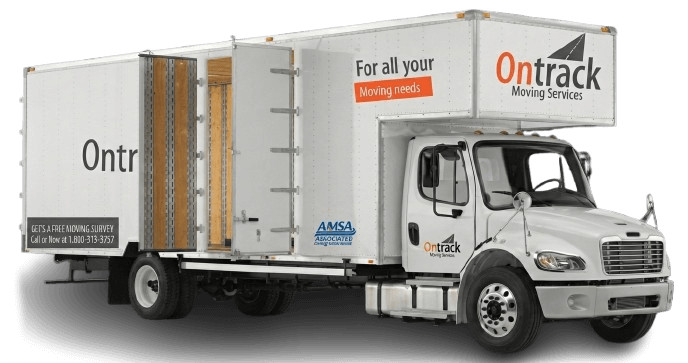
Ontrack Moving truck for a white-glove household move into a large home in Hillsborough

Planning a White-Glove Move?

High-end household moves run by our own in-house crews on our own trucks. Full-service packing, floor and stair protection, fine furniture, art, and pianos. $10M Combined Protection Tower for building and property liability.

Planning a Move? Get your free estimate.