
California Exit Series · Business Edition

Moving Your Business from California to Arizona (2026 Guide)

The tax math, the incentive programs, where to land in Arizona, the operational checklist, and the corridor logistics. Written from 15 years of asset-based interstate moves on the California to Arizona corridor.

Quick answer for California business owners weighing the move: The Arizona business case rests on four pillars. State income tax (flat 2.5 percent personal, 4.9 percent corporate vs California's 13.3 percent top marginal and 8.84 percent corporate). Cost of office space (Scottsdale Class A typically 35 to 45 dollars per square foot vs San Francisco Financial District 75 to 95 dollars). Regulatory climate (Arizona is a right-to-work state with one of the lowest regulatory burdens nationally per Mercatus Center rankings). And targeted incentive programs (Quality Jobs Tax Credit, GPLET property tax abatement, Foreign Trade Zone designations). The honest counterpoint is below.

If you have already decided and want a no-broker interstate quote, see our long-distance moving hub, the Bay Area to Phoenix corridor page, or our commercial moving hub. We are an asset-based carrier with USDOT #2551548, CA License CAL-T190721, a 0% Federal Out-of-Service Rate under FMCSA inspection, and warehouses at both ends of the corridor (Hayward CA and Peoria AZ).

TL;DR (60-Second Summary)

  • Tax math is the headline: CA top marginal 13.3% personal / 8.84% corporate vs AZ 2.5% flat / 4.9% corporate. On a 1 million dollar profitable C-corp, the corporate-rate differential alone is roughly 39,500 dollars per year.
  • Office space costs 40 to 60 percent less: Scottsdale Class A is 35 to 45 dollars per square foot. SF Financial District is 75 to 95 dollars. Phoenix downtown is 28 to 38 dollars.
  • Where to land: Scottsdale (finance, professional services), Phoenix (corporate HQ, healthcare), Mesa (operations, light industrial), Chandler (tech, semiconductor), Gilbert (small business).
  • Three incentive programs actually worth pursuing: Arizona Quality Jobs Tax Credit ($9,000 per net new job over 3 years), GPLET property tax abatement (up to 8 years in designated zones), Foreign Trade Zone reduced property tax classification.
  • Honest counterpoint: Talent pools for specific industries (entertainment, certain biotech roles), proximity to coastal customers, and summer heat tolerance still favor staying in California for some businesses.
  • Move logistics: Plan 8 to 12 weeks ahead for a small-to-mid office. Book an asset-based carrier with USDOT, not a broker. Standard $0.60/lb basic cargo liability per article applies, with additional valuation protection available.

1. California vs Arizona Business Tax Math (2026)

The headline number every accountant runs first is the state tax differential. Here is the side-by-side, current to the 2026 tax year:

Tax LineCaliforniaArizona
Personal income tax (top marginal)13.3%2.5% (flat)
Corporate income tax8.84%4.9%
LLC franchise tax (minimum)$800/yr$0
LLC filing fee$70$50
State sales tax (state portion)7.25%5.6% (TPT)
Local sales tax (typical max combined)up to 10.75%up to 11.2%
Unemployment insurance taxable wage base$7,000$8,000
Workers comp average premium per $100 payroll$1.45$0.85

A few footnotes that matter. Arizona's Transaction Privilege Tax (TPT) is technically a tax on the seller, not a sales tax. The economic effect is similar at the cash register but the compliance mechanics differ. Combined local rates in some Arizona jurisdictions can edge above California's top combined rate, so do not assume Arizona is automatically cheaper on transaction taxes. The corporate income tax difference (8.84% vs 4.9%) is the line most worth modeling for a profitable C-corp.

2. The Per-Million-Dollar Savings Estimate

To illustrate the differential, here is what the state-level tax burden looks like on a hypothetical small business at three profit levels (assumes pass-through LLC taxed at the highest applicable owner rate, single owner, no SALT cap workaround):

Annual Net IncomeCalifornia State TaxArizona State TaxAnnual Differential
$250,000~$24,000~$6,250$17,750
$500,000~$56,000~$12,500$43,500
$1,000,000~$125,000~$25,000$100,000
$2,500,000 (C-corp)~$221,000~$122,500$98,500

Estimates only. Excludes SALT cap workarounds (PTET elections), federal interaction, multi-state apportionment for businesses serving both states, and individual deductions. Talk to a CPA who handles interstate business migrations for your specific structure.

SALT cap consideration

Both California and Arizona offer Pass-Through Entity Tax (PTET) elections that work around the federal $10,000 SALT cap for owners of pass-through businesses. If your business has been using California's PTET election, the apparent state-tax differential narrows on the federal return. The Arizona PTET works similarly. Run the full math, federal interaction included, before assuming the differential equals the headline number.

3. Where to Relocate Within Arizona (City by City)

Arizona is not one market. Each metro and sub-market has a different business profile, talent pool, and physical infrastructure. The five cities worth considering for a California business relocation:

Scottsdale : Finance, Professional Services, HNW Residential, Airpark Cluster

Class A office: $35-45/sf Population: 248,000 Median household income: $99,000 Airpark companies: 2,500+

Scottsdale's economic anchors are wealth management, professional services, healthcare administration, and the Scottsdale Airpark business cluster (2,500+ companies on roughly 8 square miles around Scottsdale Airport). Class A office stock is concentrated in Old Town, Kierland Commons, North Scottsdale, and the DC Ranch corridor. Strong fit for: financial advisors, law firms, accounting practices, medical device sales, consulting firms with HNW client bases. Weak fit for: heavy manufacturing, large warehouse operations, cold-chain distribution. Premium office build, premium residential, premium parking. The address itself does signaling work.

See Scottsdale commercial moving

Phoenix : Corporate HQ, Healthcare, Government, Downtown GPLET Zone

Class A office: $28-38/sf Metro population: 5.0M Fortune 500 HQs: 5 GPLET-eligible downtown blocks

Phoenix is the regional corporate hub. Fortune 500 HQs (Avnet, Republic Services, ON Semiconductor, Freeport-McMoRan, Insight Enterprises) plus major regional employers (Banner Health, Honor Health, Wells Fargo regional). Downtown Phoenix has GPLET-eligible parcels offering up to 8 years of property tax abatement. Camelback Corridor, Biltmore, and Midtown are the primary Class A submarkets. Strong fit for: corporate HQ relocations, healthcare administration, large finance back-office, government contractors. PHX airport (Sky Harbor) is the regional anchor for travel-heavy businesses.

See Phoenix office moving

Mesa : Operations, Light Manufacturing, ASU East Valley Talent

Class B/flex space: $14-22/sf Population: 511,000 3 ASU campuses Phoenix-Mesa Gateway Airport

Mesa is the operations and light-industrial play. Lower rents than Phoenix or Scottsdale, large flex-space inventory along the Loop 202 and Loop 101 corridors, and proximity to the Phoenix-Mesa Gateway Airport for east-side cargo and corporate aviation. ASU's polytechnic campus and downtown Mesa campus produce engineering and applied tech talent. Strong fit for: light manufacturing, distribution, call centers, back-office operations, fulfillment with proximity to Sky Harbor and Gateway. Less strong: client-facing professional services that need a prestige address.

See Mesa commercial moving

Chandler : Tech, Semiconductor Supply Chain, ASU Pipeline

Class A office: $26-34/sf Population: 281,000 Intel Ocotillo + TSMC suppliers Price Corridor tech cluster

Chandler is the Arizona tech corridor. Intel's Ocotillo campus (Fab 42, Fab 52, Fab 62 under construction) anchors a deep semiconductor supply chain that also feeds TSMC's North Phoenix fab. The Price Corridor between the Loop 101 and Loop 202 holds a dense cluster of EDA, equipment, and supply-chain firms. ASU's Tempe campus is 15 minutes north. Strong fit for: hardware tech, semiconductor support, electrical engineering services, fabless design firms. Talent pool is the strongest in the metro for hardware-side roles. Software pure-plays may still find SF or Seattle deeper for senior engineering talent.

See Chandler commercial moving

Gilbert : Small Business, Family-Owned Operations, Lower Office Cost

Class B office: $20-26/sf Population: 285,000 SanTan Village commercial core Low business filing fees

Gilbert is the family-business and small-operations choice. Heritage District and SanTan Village concentrate small-to-mid commercial inventory at meaningfully lower rates than Scottsdale or even Chandler. Strong fit for: small professional firms (5 to 25 person), medical practices, consultancies, home-based businesses ready to graduate to a first office, family-owned retail and trade businesses. The municipal business climate is among the most operationally friendly in the East Valley.

See Gilbert commercial moving

4. Incentive Programs You Can Actually Use

Most "incentive" press releases are noise. Three Arizona programs are durable and worth pursuing for an inbound California business:

Arizona Quality Jobs Tax Credit

Administered by the Arizona Commerce Authority (ACA). Pays $3,000 per net new job per year for up to 3 years ($9,000 per job total) for businesses that meet wage thresholds (typically 100% of county median wage), invest minimum capital ($5 million in metro, less in rural), and add a minimum number of new jobs (25 in metro, 5 in rural). The credit is non-refundable but transferable in certain cases. Best fit: businesses adding 25+ net new jobs at decent wages within 3 years of relocation. Apply BEFORE making the move, not after.

GPLET (Government Property Lease Excise Tax)

Designated downtown redevelopment zones in Phoenix, Tempe, Mesa, and parts of Scottsdale can structure commercial real estate as a city-owned lease-back, replacing property tax with a lower excise tax for up to 8 years. The mechanics: the city takes title to the property, the business leases it back, and pays GPLET instead of full property tax. The window is project-specific and time-limited. Best fit: new construction or substantial rehabilitation in designated zones; not applicable to standard office leases in regular submarkets.

Foreign Trade Zone (FTZ) Designation

Arizona has 7 active Foreign Trade Zones. Operating in or relocating to an FTZ allows reduced or deferred customs duties on imported components and, separately, a reduced 5% property tax assessment ratio (vs the standard 18% commercial classification). Best fit: businesses with significant imported inventory or components moving through Arizona. Phoenix-Mesa Gateway Airport area, Sky Harbor area, and several industrial parks offer FTZ subzones.

Tax-credit broker warning

If a "site selection consultant" or "economic development consultant" approaches you claiming a locked-in credit package, get a second opinion. Many legitimate firms work this space, but a smaller number stack speculative credits and charge fees against credits the business cannot actually use. Run any incentive proposal past your CPA before signing.

5. The Unsexy Operational Checklist (12 to 16 Weeks Out)

The state tax math is the headline. The operational checklist is what actually consumes the next 12 to 16 weeks. The honest sequence:

  1. Engage a business attorney and CPA who handle interstate domestication. Decide between LLC domestication (preserves continuity, same EIN) and dissolve-and-reform (cleaner accounting, restart). 4-week lead time.
  2. File AZ Articles of Domestication or new entity formation with the Arizona Corporation Commission. 2 to 4 weeks for approval depending on filing volume.
  3. Register with Arizona Department of Revenue for TPT (Transaction Privilege Tax) license if you sell goods or taxable services. Same-day to 1-week turnaround online.
  4. Register with Arizona Department of Economic Security for unemployment insurance and new-hire reporting.
  5. Open Arizona business bank accounts at a regional bank with branches in your destination metro. Wait until the AZ entity is approved before opening accounts in the AZ entity's name.
  6. Negotiate the destination lease. If pursuing GPLET, route the deal through the host city's Economic Development office BEFORE signing. Typical 60 to 90-day lease negotiation window for Class A.
  7. California wind-down planning. File CA Final Tax Return (Form 568 or 1120 final). Surrender CA seller's permit at the Board of Equalization (now CDTFA). File Statement of Information final. EDD final wage report if you had CA employees.
  8. Employee transitions. Relocation packages negotiated, severance and final paychecks for non-relocating staff scheduled per CA labor law (same-day for terminated, 72-hour for resigned, accrued PTO paid out in full). WARN Act notice if 50+ employees affected.
  9. Customer and vendor communication. 60-day formal notice of address change. New W-9s to vendors. Updated ACH details. Domain DNS for any geo-routed services.
  10. Physical move planning. Engage an asset-based carrier with USDOT and CA license verified. Inventory the relocation. Pre-pack IT infrastructure under documented protocols. Schedule the "Friday-to-Monday" cutover window.
  11. Insurance updates. General liability, workers comp (re-rated for AZ classifications), commercial auto if you operate vehicles, cyber, professional liability. AZ rates typically run lower; quote AZ-domiciled carriers and your existing California carrier.
  12. Update credentials and licenses. Industry-specific licensing (legal, medical, real estate, contractor, etc.) almost always requires AZ-state credentialing in parallel with CA wind-down. Plan 60 to 120 days for most professional credentials.
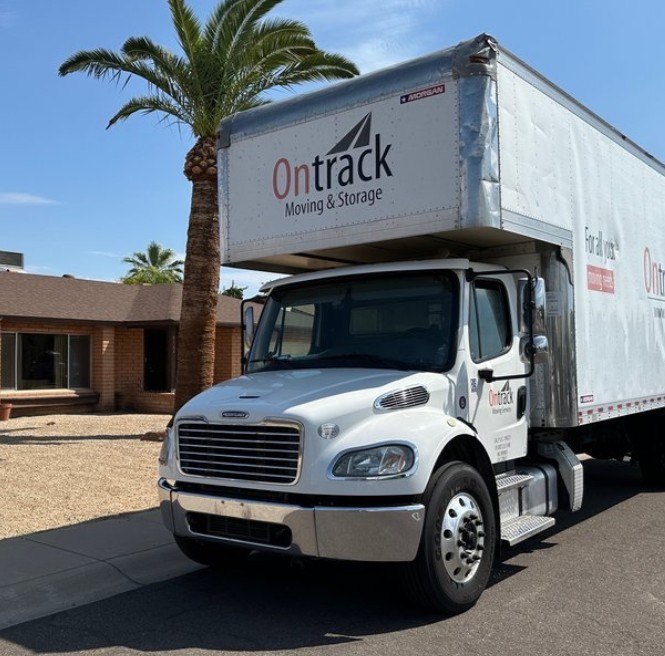
Ontrack Moving asset-based interstate truck on the California to Arizona corridor

Direct Carrier. We Own the California to Arizona Corridor.

22950 Clawiter Rd, Hayward CA 94545
8662 N 78th Ave, Peoria AZ 85381

Same foreman from pickup to delivery. No broker handoffs. Asset-based carrier under USDOT #2551548 with a 0% Federal Out-of-Service Rate. Member of the Arizona Moving Association and the Scottsdale Chamber of Commerce. Standard $0.60/lb basic cargo liability per article applies, with additional valuation protection available on request.

(510) 887-1088

6. When NOT to Move Your Business to Arizona

The pro-Arizona narrative gets too much airtime. Some businesses should not move. The honest counterpoint:

5 cases where staying in California is the right call

  1. Your customer base is geographically California-concentrated. If 70%+ of revenue comes from California-domiciled clients and the relationships depend on in-person presence, the move adds travel cost and relationship risk that may offset tax savings for years.
  2. Your talent pool is California-specific. Senior software engineering, certain biotech roles, entertainment and media production, certain venture-backed startup roles still have deeper talent pools in the Bay Area, LA, and San Diego than anywhere in Arizona. Recruiting cost rises.
  3. You depend on California-specific permits or licenses. Certain industries (cannabis, specific healthcare specializations, alcohol distribution, certain construction trades) have CA-issued licenses that do not transfer or take years to re-establish.
  4. You sell to California consumers and the move triggers nexus complications. Continuing to ship goods or services to California customers means continuing California TPT/sales tax nexus filings, California payroll if you keep CA-resident employees, and California Franchise Tax Board scrutiny on apportionment. The compliance burden may not actually shrink.
  5. Summer heat tolerance is a real factor for your team. If your business depends on outdoor work, field operations, or just retention of California-acclimated staff, the Phoenix-area heat (110+ days above 100°F per year, peak 110 to 118°F) is not a marketing problem. It is an operational one for the first 12 to 18 months.

7. Move Logistics : The Corridor

Once the decision is made, the physical move itself is a discrete project with a knowable cost and timeline. For a California to Arizona business relocation, three things separate a clean cutover from a 2-week recovery:

Asset-based carrier, not a broker

The most common interstate-move failure mode is booking a broker who then re-sells the job to a low-bid carrier. The broker collects a deposit, the actual carrier shows up late or with a different crew than promised, the load gets transferred between trucks at a warehouse mid-route, and the customer has no recourse because the contract is with the broker, not the company that physically handled the inventory. Verify USDOT and MC numbers before booking. Confirm asset-based (the company owns the trucks and employs the crew) by asking for fleet size, warehouse addresses, and direct-employee crew count.

Same crew, same foreman, pickup to delivery

For a business relocation specifically, continuity of crew matters more than for a household move. A foreman who labels the load at origin should be the same foreman who places it at destination. This is feasible only with asset-based carriers running a verified 2-truck or 3-truck convoy on the corridor, not with brokered loads that swap drivers at fuel stops. Ask the moving company directly whether the crew rides with the load end-to-end.

Thermal staging for summer interstate transit

Phoenix-area trailer-bed temperatures exceed 130°F by mid-morning between June and September. IT infrastructure, electronics, climate-sensitive office furniture (genuine leather, certain veneers), and any cold-chain inventory require thermal-staged loading and route discipline. The Ontrack thermal-staging protocol: pre-dawn loading windows (4 to 8 AM Pacific), climate-aware load order (electronics last in, first out), thermal barriers on sensitive cases, direct I-10 transit without overnight stops in trailer-only configurations, and morning unloading windows at destination. Detailed summer protocol here.

Liability armor for business loads

Standard federal interstate cargo liability is $0.60 per pound per article. For a business load where individual items (servers, monitors, custom furniture) have replacement value far above their weight, that floor is inadequate. Ask the carrier about additional valuation protection options before signing. Separately, the $10 million Combined Protection Tower covers building and property protection at origin and destination (general liability for damage to elevators, lobby finishes, third-party property) but does not cover individual item replacement. Both coverages should be on your COI request.

8. Frequently Asked Questions

For most small and mid-size businesses, yes, with planning. The typical operational downtime window for a California to Arizona business relocation is 48 to 96 hours, depending on whether you run a "Friday-to-Monday" migration (offices, light operations) or a phased move (warehouses, light manufacturing, retail with inventory). Heavier operations with cold-chain, large equipment, or regulated processes plan 2 to 3 weekends with continuous operation maintained via temporary parallel locations. A direct asset-based carrier with USDOT-verified authority on the corridor is the difference between a clean weekend cutover and a 2-week recovery.

A 10 to 25 person office runs 1 to 2 days of physical loading at origin, 1 to 2 days of transit on the I-10 or I-40 corridor, and 1 to 2 days of unloading and re-set at destination. A 50 to 100 person operation runs 2 to 4 days of loading, same transit, and 3 to 5 days of unloading. Plan the customer-visible cutover for a Friday afternoon load and a Monday morning operational launch. IT, phones, and core servers stage first and re-rack first.

For an asset-based carrier with no broker handoff: a 10 to 25 person office relocation from the Bay Area to Phoenix or Scottsdale typically runs 18,000 to 35,000 dollars including labor, materials, and transit. A 50 to 100 person operation runs 60,000 to 150,000 dollars depending on cubicle counts, IT infrastructure, and specialty equipment. Standard $0.60 per pound per article basic cargo liability applies to all interstate moves, with additional valuation protection available on request. Brokers often quote 30 to 40 percent lower up front and adjust on the back end after the deposit is taken.

You have two paths. Path one: domesticate the existing California LLC to Arizona via the AZ Corporation Commission (file Articles of Domestication, retain the same EIN, surrender the CA entity via FTB Final Return). Path two: form a new AZ LLC and dissolve the CA entity after the wind-down. Path one preserves continuity of contracts, accounts, and credit history. Path two is cleaner for accounting if you also want to restructure. Talk to a business attorney who handles interstate domestication, especially if you have California-source contracts, real property, or California employees continuing post-move.

Three options. Option one: offer relocation packages (typical 8,000 to 25,000 dollars for individual contributors, higher for senior staff). Option two: transition employees to remote-work status under California payroll until natural attrition; this requires keeping a California employer-of-record presence and continuing CA SDI, EDD, and workers comp. Option three: severance and separation under California labor law, including final paycheck rules (same-day for terminated, 72-hour for resigned), accrued PTO payout, and WARN Act notice if you cross 50+ affected employees. California Final Termination Pay rules are stricter than most states.

The $10 million Combined Protection Tower covers building and property protection during the move: general liability for damage to origin and destination buildings, elevator floors, lobby finishes, and third-party property. It is pre-configured to meet the high-limit COI requirements of Class A buildings in San Francisco (1 California, Salesforce Tower) and major Phoenix and Scottsdale corporate campuses. It does NOT cover the replacement value of individual items being moved; that is a separate basic $0.60 per pound per article cargo liability per federal FMCSA requirement, with additional valuation protection available on request.

GPLET (Government Property Lease Excise Tax) is an Arizona property tax abatement program that can reduce or eliminate property tax for up to 8 years on qualifying commercial real estate located in designated downtown redevelopment areas of Phoenix, Tempe, Mesa, and parts of Scottsdale. The structure: the city takes title to the property, you lease it back, and pay the lower excise tax instead of full property tax. Qualifying projects typically involve new construction, substantial rehabilitation, or specific redevelopment district locations. Talk to the host city Economic Development office and a real estate attorney before signing a lease; GPLET windows are project-specific and time-limited.

Yes. Phoenix summer trailer-bed temperatures exceed 130 degrees Fahrenheit by mid-morning. Standard Ontrack protocol for IT-heavy and electronics-heavy interstate loads in summer: pre-dawn loading windows (4 to 8 AM Pacific), climate-aware load order (electronics loaded last and unloaded first), pad-wrap with thermal barrier on sensitive cases, and direct-route I-10 transit to minimize trailer dwell time at desert truck stops. For server racks, monitors, and printers a non-stop transit window is preferred. Lab equipment, biosafety cabinets, and cold-chain inventory follow separate protocols documented on our laboratory moving page.

Related Reading

KEEP READING

Related Articles

California Exit Series

10 Signs It Is Time to Leave California for Arizona (2026 Honest Guide)

A data-backed honest look at the California to Arizona migration. Housing cost gap, state income tax differential, gas and electricity, retirement math, school choice, and the honest counterpoint on when staying in California is the better call. Plus interstate move logistics from a 15-year asset-based carrier.

14 min read Read
Scottsdale Relocation Guide

Best Neighborhoods in Scottsdale, AZ for Families & Professionals

Where to live in Scottsdale: Old Town for walkability; McCormick Ranch, Grayhawk, and DC Ranch for families. Plus the Scottsdale Unified School District record (all 29 brick-and-mortar schools earned an A or B in the 2024 state report cards) and city safety data, with every figure sourced.

8 min read Read
About this guide: Tax data points sourced from California Franchise Tax Board, Arizona Department of Revenue, Tax Foundation 2026 State Business Tax Climate Index, and Arizona Commerce Authority. Office rent ranges sourced from CBRE Q1 2026 Phoenix Office MarketView and JLL San Francisco Office Insight. Numbers approximate and vary by submarket, year, and lease structure. This is not legal, tax, real estate, or investment advice. Talk to a CPA and business attorney who handle interstate business migrations for your specific situation. Move logistics described reflect Ontrack Moving® standard interstate practice as a USDOT-registered asset-based carrier (USDOT #2551548, CA License CAL-T190721, 0% Federal Out-of-Service Rate). Standard $0.60 per pound per article basic cargo liability applies to all interstate moves, with additional valuation protection available on request. Ontrack Moving® is a member of the Arizona Moving Association and the Scottsdale Chamber of Commerce.