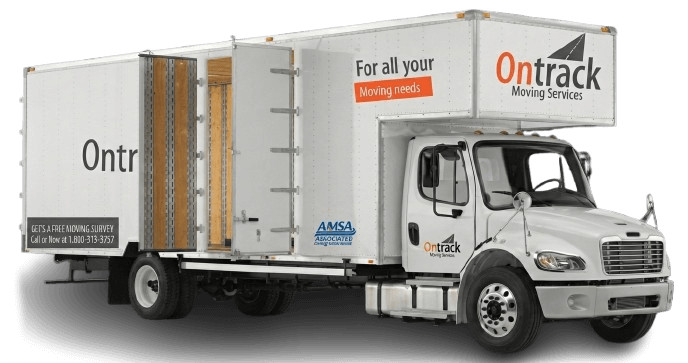
Quick answer: A standard 26-foot box truck has a cargo box measuring 25'2" long by 7'8" wide by 8'1" tall, giving it 192 sq ft of floor space and 1,560 cubic feet of geometric volume. Real usable capacity is closer to 1,400 cubic feet after walking space, blanket padding, and irregular furniture shapes.
In storage, that full truckload typically fills 7 wooden vaults at 200 effective cubic feet per vault. When the shipment includes exercise equipment such as Peloton bikes, multiple TVs, large mirrors, glass-top tables, chandeliers, marble pieces, plants, BBQs, trampolines, or fragile antiques, the same truckload can require 8 or 9 vaults because those items need extra space, padding, and separation.
Need pricing for your specific inventory? See our storage pricing page for current vault rates, warehouse locations, and how to book a storage in transit period as part of your move.
TL;DR (30-Second Summary)
- 26-foot box truck: 25'2" x 7'8" x 8'1" cargo interior, 192 sq ft floor, 1,560 cu ft geometric, 1,400 cu ft real capacity (about 90% fill).
- Storage vault: 7' x 7' x 5' wooden vault, 245 cu ft geometric, 200 cu ft effective (about 82% fill).
- The rule: 1 full truck = 7 vaults (1,400 / 200 = 7 exactly).
- The non-stackable exception: the same truckload needs 8 or 9 vaults when it contains exercise equipment, multiple TVs, mirrors, glass tops, chandeliers, plants, BBQs, trampolines, or fragile antiques.
- The accumulation exception: a normally one-truck home can become 2, 3, or 4 truckloads when garages, patios, attics, and decades of belongings are added to the count.
26-Foot Box Truck Specifications
Most asset-based residential moving carriers in California and Arizona, Ontrack Moving included, run 26-foot box trucks as the workhorse vehicle for local and long-distance move planning. These trucks share a standard cargo specification across the major chassis manufacturers (Freightliner, Hino, International, Isuzu). The dimensions below describe the cargo box that actually holds the customer's belongings, separate from the overall vehicle footprint that determines whether the truck fits in a driveway or under a porte-cochere.
| Overall length (cab + box) | 37 ft |
| Overall width | 8 ft 7 in |
| Overall height | 13 ft 1 in |
| Cargo box interior length | 25 ft 2 in |
| Cargo box interior width | 7 ft 8 in |
| Cargo box interior height | 8 ft 1 in |
| Cargo floor area | 192 sq ft |
| Geometric cargo volume | 1,560 cu ft |
| Effective usable capacity | 1,400 cu ft |
| Effective fill ratio | about 90% |
Overall vehicle versus cargo box: two sets of dimensions
The 37-foot overall length covers the truck cab, hood, and the back overhang. The cargo box itself is 25 feet 2 inches, or just over 25 feet. That difference matters when judging whether the truck can park near a townhouse, navigate a private road, or fit under a covered driveway. The 13 feet 1 inch overall height clears most residential overhangs but cannot pass under porte-cocheres or arches lower than 13 feet 6 inches, which excludes many high-end hotel front entrances, some gated-community entry features, and a number of older urban underpasses.
Why 1,400 cubic feet is the number that matters, not 1,560
Multiply 25.17 by 7.67 by 8.08 and the cargo box geometric volume comes out to 1,560 cubic feet. That number is correct, but it describes the empty box. Once a loading crew is working inside that box, the realistic usable volume drops to about 1,400 cubic feet, or roughly 90 percent of the geometric maximum.
Where the 160 cubic feet go
Three factors eat the gap between 1,560 cu ft geometric and 1,400 cu ft usable: (1) walking space and a working aisle for the loaders, who need to move around the cargo while stacking; (2) blanket padding wrapped around furniture, which adds 1 to 2 inches around every wrapped piece (see our packing guide for the protection standards we use on TVs, mirrors, and artwork); (3) irregular furniture shapes (curved sofas, headboards, lamp shades, L-shaped desks) that cannot tessellate cleanly against rectangular cargo walls.
The 1-Truck = 7-Vault Rule (And When It's Wrong)
The math is clean: a 26-foot truck holds 1,400 cubic feet of usable cargo, a wooden storage vault holds about 200 cubic feet of usable storage, and 1,400 divided by 200 is exactly 7. One full truck equals 7 vaults. This rule works for most household moves and is what our estimators reach for first when sizing a storage component into a quote.
But not every truckload. When the inventory is heavy on non-stackable items, the same physical cargo can require 8 or 9 vaults at the warehouse. The items do not shrink. They just do not pack as efficiently into rectangular vaults as they did into the truck.
Items That Push a Load From 7 Vaults to 8 or 9
- Exercise equipment, such as Peloton bikes, treadmills, ellipticals, stationary bikes, weight racks, and home-gym machines (bulky, awkward, often cannot be safely stacked)
- Multiple flat-screen TVs (each one claims a vault corner of its own)
- Large mirrors, paintings, framed artwork
- Glass-top tables, marble pieces
- Chandeliers, pendant fixtures
- Plants, tall planters
- BBQs, outdoor grills
- Trampolines
- Fragile antiques
- Odd-shaped furniture (curved sofas, custom builds, L-shaped desks)
Why a vault holding a Peloton fills at 60 percent, not 100
A Peloton bike is roughly 60 inches tall, 24 inches wide, and 60 inches deep, with a touchscreen and electronics mounted on top. Stack anything on that touchscreen and the screen breaks, the frame bends, or both. So the vault holding the Peloton has the bike standing upright, blankets padding the screen and frame, and the remaining 40 percent of the vault space intentionally left empty. That is the operationally correct answer. It is also why the same 1,400 cubic feet of inventory can need 8 vaults instead of 7.
The same logic applies to a vault holding 4 large flat-screen TVs (each one needs its own padded corner, no stacking, see our protecting TVs and artwork standards), a vault holding a marble dining-table top (cannot have weight set on it), or a vault holding a chandelier (suspended from straps, surrounding space stays empty for swing clearance).
Pro tip for the estimate stage
When requesting a quote that includes storage, walk the estimator through the non-stackable items up front. A walkthrough that misses the Peloton, the chandelier, or the trampoline produces a vault count that is short by 1 or 2 vaults, which can make the original storage estimate too low.
Storage Vault Math: 7-by-7-by-5 Wooden Vaults
Storage in transit, or SIT, is the standard interim storage product used between move-out and move-in dates for residential customers. Items are wrapped on the moving truck at the origin, then transferred into wooden storage vaults at the carrier's warehouse, sealed with the customer's inventory tag, and held until the redelivery date. Ontrack runs vault storage at two warehouses: Hayward, California and a climate-controlled Peoria, Arizona facility. Both use 7-by-7-by-5 wooden vaults.
| Vault external dimensions | 7 ft x 7 ft x 5 ft |
| Geometric volume | 245 cu ft |
| Effective storage capacity | about 200 cu ft |
| Effective fill ratio | about 82% |
| Construction | Plywood walls, breathable seam joints |
| Climate control | Available in the Peoria, AZ warehouse |
Geometric 245 cubic feet versus effective 200 cubic feet
A 7-by-7-by-5 vault has a geometric internal volume of 245 cubic feet (7 x 7 x 5 = 245). That is the dimensional spec and the number that often appears on storage product pages. But the practical, day-to-day usable storage capacity is closer to 200 cubic feet per vault.
The 45 cubic-foot gap between geometric (245) and effective (200) is consistent across the industry. It comes from three things: (1) blanket padding wrapped around every furniture item adds 1 to 2 inches around the piece; (2) irregular shapes cannot fully fill a rectangular vault, leaving small voids in the corners; (3) the no-stack rule on delicate items forces empty space above them. Both 245 and 200 are correct numbers. 245 describes the empty vault. 200 describes what actually fits inside it during a real load.
Why vaults fill less efficiently than trucks (82 percent versus 90 percent)
The truck reaches about 90 percent of its geometric volume; the vault reaches about 82 percent. The 8-point gap is not random. A truck is loaded actively at the residence, with the crew rearranging and re-stacking as more items come on board. A vault is loaded once at the warehouse, in a single pass, with no opportunity to reorganize. The truck loader has tetris flexibility; the vault loader has one shot. The vault also stays sealed for the duration of the storage period, which means anything fragile or top-heavy that goes in stays exactly where it is placed, often with intentional empty space around it.
How to Estimate Trucks and Vaults for Your Move
A proper household moving estimate comes from a walkthrough or video inventory, not from a rule of thumb. That said, rule of thumb is useful at the planning stage when a customer is comparing carriers, sizing a budget, or working through a broader moving checklist before booking.
By bedroom count
The ranges below assume a normally-packed home with typical furniture density and modest patio or garage inventory. Two adjustments described in the next section may push the final numbers up.
| Home size | Cubic feet (range) | Trucks | Vaults (standard) |
| Studio | 300 to 600 | 1 (partial) | 2 to 3 |
| 1-bedroom apartment | 500 to 900 | 1 (partial) | 3 to 5 |
| 2-bedroom home | 1,200 to 1,800 | 1 to 2 | 6 to 9 |
| 3-bedroom home | 1,800 to 2,800 | 2 | 9 to 14 |
| 4-bedroom home | 2,800 to 4,000 | 2 to 3 | 14 to 20 |
| 5+ bedroom estate | 4,000+ | 3+ | 20+ |
By square footage of furnished space
A faster planning estimate uses square footage of fully furnished living space. The practical field rule: a 1,600 sq ft home generally fits inside one 26-foot truck (about 1,400 cubic feet) when the household is normally packed and there is not significant patio, garage, or outdoor inventory. Two variables push the count up. First, outdoor and garage inventory (BBQ, patio furniture, lawn equipment, garage gym, tool storage) often adds 200 to 600 cubic feet that does not show up in the interior square footage at all. Second, how densely the home has been lived in matters more than the square footage itself. At the extreme, heavily-accumulated homes can require 3 or 4 truckloads from the same 1,600 sq ft when decades of belongings have built up across closets, garages, attics, basements, and external rented storage. The square-footage rule is a starting point; an inventory walkthrough is the only way to know.
Two adjustments to the rule of thumb
Two factors can move a real job off the rule-of-thumb table above. They are independent of each other and can both apply to the same job. Knowing which factor (or factors) is in play is the difference between an accurate quote and one that runs short.
Factor 1: The accumulation factor (more cubic feet than expected)
This means the home has more actual cubic feet than the square footage would suggest. The dominant signals:
- Heavily-packed garage or workshop
- Large patio or outdoor inventory (furniture, planters, grills, sheds)
- Tool storage and workshop inventory
- Garage gym
- Full attics, basements, and walk-in closets
- External rented storage that needs to ride too
- Decades of belongings (heavily-accumulated or hoarder-level homes)
A normally one-truck 1,600 sq ft home can become 2, 3, or even 4 truckloads when this factor is significant. The cubic-feet count goes up. So does the truck count.
Factor 2: The non-stackable factor (more vaults per cubic foot)
This means the cubic feet may be accurate, but the load needs more vaults because the items cannot be stacked efficiently. Common offenders (see the full list in the 7-vault rule section above):
- Exercise equipment (Peloton bikes, treadmills, ellipticals, weight racks)
- Multiple flat-screen TVs
- Mirrors, paintings, framed artwork
- Glass tops, marble pieces
- Chandeliers
- Plants
- BBQs and trampolines
- Fragile antiques and odd-shaped furniture
A normal 7-vault full truck can become 8 or 9 vaults when this factor is significant. The truck count may not change, but the vault count goes up.
Both factors can apply on the same job
A heavily-accumulated home with a Peloton, six TVs, a chandelier, and a marble dining table is hit by both adjustments. Accumulation increases the total cubic feet (and therefore the truck count). Non-stackable inventory reduces vault efficiency (and therefore raises the vault count per truck). The two adjustments stack and the final estimate reflects both. This is why an in-home or video walkthrough beats any rule of thumb the moment a home has either of these characteristics.
Why Real Estimates Beat Rule of Thumb
The bedroom and square-footage rules above are useful as a sanity check, not a final number. They miss the things that drive variability between two outwardly similar homes.
The missing-data problem
Two 3-bedroom homes can hold very different volumes of belongings. One has a converted garage gym with a Peloton, a Tonal, and a rack of dumbbells. One has a library with 40 shelf-feet of books and 6 framed maps (each frame is its own packing fragile items decision: dust jackets, glass over the prints, original art). One has a den with 4 mounted TVs and a collection of audio equipment. One has a wine cellar with a 200-bottle wine fridge and 3 large wine racks. None of those show up in "3-bedroom home" but each adds 100 to 400 cubic feet of inventory, often in items that need their own handling protocol.
How a walkthrough or video inventory tightens the estimate
The most accurate estimate comes from a walkthrough with an estimator (in-home or via video) who tags each item against a moving inventory list. The list translates to cubic feet and to vault count. For Ontrack customers, that walkthrough takes 30 to 45 minutes for a typical home and 60 to 90 minutes for a large or multi-room estate. The resulting estimate is generally within 5 to 10 percent of the actual loaded volume, compared with rule-of-thumb estimates that can run 20 to 30 percent off.
For vault rental rates, warehouse details, and how to book a storage period as part of your move, see /storage. For interstate moves where truck capacity is the bottleneck on a fixed timeline, see our interstate move page. When you are ready to size your move against this math, request a quote and we will walk the inventory with you in person or by video.